
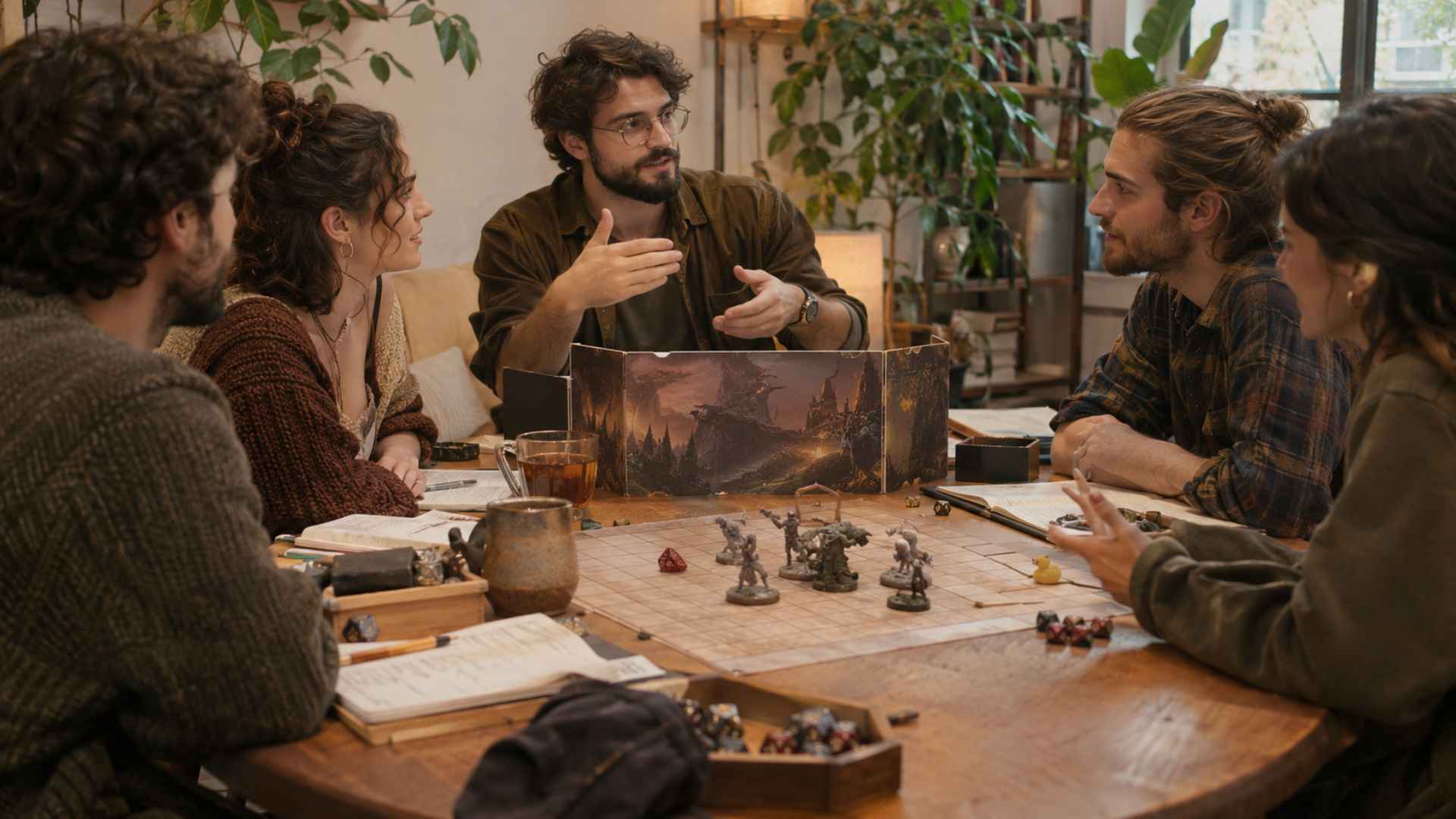
Tabletop role playing games depend on more than rule systems, character abilities, or elaborate fictional settings. Every session is shaped by the people who participate, the choices they make, and the attention they give one another. Players interpret situations through their characters, while a game master often presents challenges and manages the shared world. Since no participant controls the entire story, engagement develops through an ongoing exchange of ideas, decisions, and reactions. Even a simple conversation with a non player character can become important when several players pursue different objectives.
Group dynamics influence whether that exchange remains enjoyable over time. Enthusiastic players may still struggle when expectations differ, discussions become one sided, or campaign schedules repeatedly fall apart. Research on tabletop role playing games increasingly examines these social conditions rather than treating enjoyment as a product of game mechanics alone. Its findings suggest that meaningful participation, supportive relationships, and clear expectations deserve attention alongside adventure design. These considerations apply to short adventures as well as campaigns that continue for months.
Player Agency and Shared Participation
Player agency refers to the ability to make choices that have recognizable consequences within the fictional world. When a character’s decision changes an encounter, opens an alternative path, or affects another character, the player has a reason to follow the story closely. Agency does not require unrestricted freedom. Rules, fictional circumstances, and other participants’ decisions establish boundaries that make choices meaningful. Problems arise when those boundaries become so rigid that contributions appear irrelevant. Offering multiple credible solutions can preserve the difficulty of a challenge without prescribing its resolution.
Motivation research offers a useful framework for this experience. In a 2006 series of studies, Richard Ryan, Scott Rigby, and Andrew Przybylski identified autonomy, competence, and relatedness as factors associated with enjoyment and continued interest in video games. Although those experiments did not specifically test tabletop groups, the concepts help explain why player choice, achievable challenges, and social connection matter at the table. Game masters can support participation through varied approaches to obstacles, while players can create opportunities for quieter group members to act. Such invitations are preferable to forcing anyone into the spotlight.
Group Cohesion and the Role of Facilitation
Group cohesion concerns the sense that participants belong to a cooperative social unit. Tabletop campaigns can establish this connection through repeated meetings, shared fictional achievements, and mutual support. In a 2026 study published in the Journal of Community & Applied Social Psychology, researchers surveyed 305 Dungeons & Dragons participants in New Zealand. Respondents generally rated their groups positively for support and social compatibility, and these ratings were associated with well being and self esteem. The study reported associations rather than proving that playing caused those outcomes. Its sample also limits generalization to all age groups and gaming communities.
Facilitation also matters because participants do not automatically receive equal opportunities to contribute. Joe Lasley and Antonio Ruiz Ezquerro analyzed more than 400 survey responses from Dungeons & Dragons fifth edition players for research published in the International Journal of Role Playing. Their analysis identified interrelated factors involving facilitation, clarity, cohesion, support, and creativity. The findings support examining the social environment as a connected system, although survey data cannot establish a simple cause and effect relationship between any two factors. In practical terms, fair turn taking and consistent rulings can make expectations easier to follow.
Communication, Conflict, and Long Term Attendance
Clear communication can prevent fictional disagreements from becoming personal disputes. Before a campaign, groups often use a session zero to discuss the game’s tone, expected attendance, character cooperation, and content boundaries. During sessions, periodic check ins provide a chance to address pacing, missed opportunities, or uncomfortable material. These practices are especially relevant when participants disagree about whether a campaign should emphasize tactics, character drama, investigation, or humor. Written group agreements can also provide a reference when memories of earlier decisions differ.
Conflict research provides another reason to establish expectations. Sarah Lynne Bowman’s qualitative study of 30 role playing participants identified differences in creative goals, game master authority, and overlap between character emotions and personal feelings among potential sources of tension. The sample covered tabletop, live action, and virtual role playing, so its themes should not be treated as universal rates of conflict in tabletop groups. Nevertheless, the findings point to practical safeguards: distinguish character disputes from player concerns, allow respectful disagreement, and address problems outside the fictional scene when necessary.
Continued attendance depends on more than excitement about the next plot development. Research examining social support among 186 tabletop role playing participants found that greater social support was associated with ongoing attendance, while consistent participation and familiarity were related to support exchanged within groups. The study also reported meaningful support in both in person and virtual play. For established campaigns, predictable scheduling, clear recaps, and flexibility around occasional absences can reduce practical barriers without pressuring players to prioritize a game over other responsibilities. Ending sessions at an agreed time can be equally important.
Sustained engagement ultimately rests on a balance between individual contribution and collective responsibility. Game masters can prepare situations that invite different responses, but they need not carry every conversation or solve every interpersonal difficulty. Players contribute by sharing attention, honoring agreed boundaries, and remaining open to outcomes they did not anticipate. Tabletop role playing works best as a collaborative activity in which the story belongs to the entire group, and regular communication helps that collaboration remain worthwhile.