
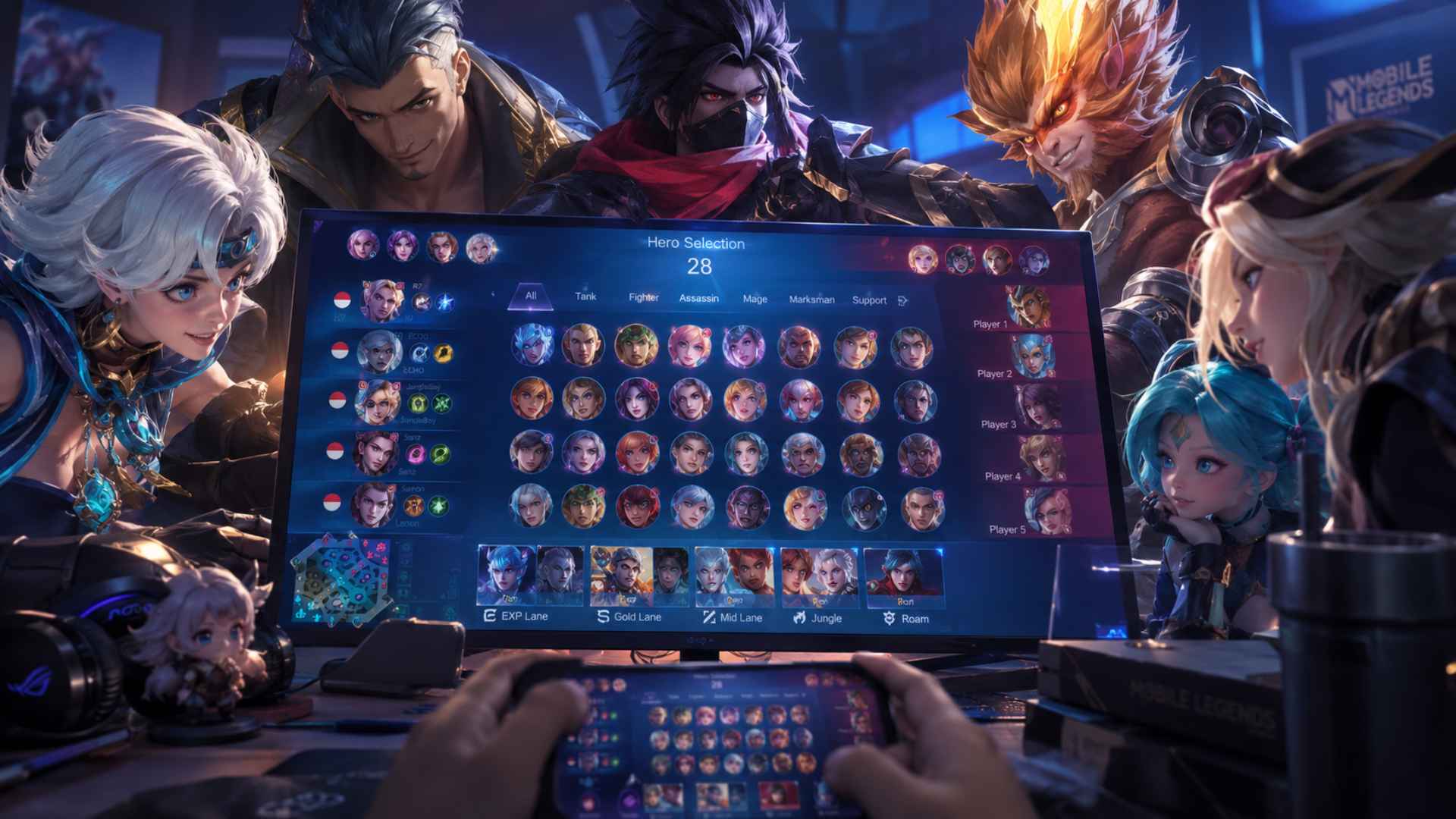
Mobile Legends: Bang Bang is a five-versus-five multiplayer online battle arena game in which each player controls one hero. Victory involves more than collecting eliminations: teams advance through lanes, defend their turrets, and ultimately destroy the opposing base. Hero selection therefore shapes both personal decisions and the options available to teammates. Choosing a familiar character without considering the rest of the lineup can leave important jobs uncovered, including frontline protection, dependable damage, and crowd control during major fights. The right selection is not always the hero who deals the most damage.
The game divides heroes into six classes: Tank, Fighter, Assassin, Mage, Marksman, and Support. Meanwhile, a standard team assigns its five players to EXP Lane, Gold Lane, Mid Lane, Jungle, and Roam. These categories describe different aspects of a match. Classes indicate general combat strengths, while positions determine farming priorities and movement around the map. Some heroes have two class labels or can perform more than one battlefield job. Effective selection means considering a character’s abilities, the team’s composition, and the player’s ability to carry out the assigned responsibilities.
Hero Classes and Combat Responsibilities
Tanks are generally built to absorb damage, disrupt opponents, and protect less durable teammates. Franco and Khufra, for example, can interfere with enemy movement through crowd control, although their abilities work differently. Fighters combine damage with some capacity to survive extended exchanges, making heroes such as Balmond or Dyrroth suitable for close-range combat. Assassins, including Saber and Hayabusa, focus on eliminating vulnerable targets through well-timed attacks. These classes can all threaten opponents, but their positioning differs: a tank may initiate a fight, while an assassin often benefits from waiting until an opening appears.
Mages commonly provide skill-based magical damage and crowd control. Nana and Vexana illustrate different ways magical abilities can influence a fight. Marksmen such as Layla and Beatrix generally rely on ranged attacks and equipment progression to become reliable damage sources, making safe positioning particularly important. Supports contribute healing, shields, protection, or other utility; Rafaela and Floryn are examples. Role labels are useful starting points, not strict restrictions. Hybrid characters may combine traits from two classes, but players should examine their actual skills rather than assume that every hero within a class performs identically.
Matching Roles to Map Duties
The EXP Lane favors heroes capable of surviving isolated exchanges and maintaining pressure without constant assistance. Fighters frequently suit that assignment because experience from the lane helps them develop their abilities. Gold Lane players prioritize income from minions so item-dependent heroes, particularly marksmen, can increase their damage as the match progresses. Mid Lane typically suits mages who can clear waves and move toward nearby fights. None of these positions should be treated as a permanent boundary. After clearing a wave, helping teammates or contesting a nearby objective may matter more than remaining in one lane.
Jungle and Roam have different resource patterns. Junglers defeat neutral monsters, build momentum through visits to lanes, and help secure the Turtle and Lord, which provide strategic benefits. The Retribution battle spell is associated with the jungler’s ability to contest jungle objectives. Assassins and some fighters are common jungle choices, although suitable picks depend on their skills and the current game balance. Roamers instead move between teammates, provide vision through safe positioning, and assist with initiation or protection. Tanks and supports often fill this position because their value comes from helping others rather than concentrating on personal farm.
Hero Selection, Practice, and Draft Decisions
Team composition should influence the final pick. When several teammates already favor damage-focused heroes, another fragile attacker may leave the group without reliable protection or initiation. Conversely, a lineup dominated by durable heroes may struggle to threaten opponents if it lacks sufficient damage. It also helps to consider physical and magical damage, crowd control, range, and the ability to attack turrets. No fixed combination guarantees a victory, since player coordination, opponents’ choices, and decisions during the match all matter. A familiar hero who fits an unfilled position may be more useful than a popular pick assigned to the wrong job.
Personal playstyle provides another practical filter. Players who enjoy direct exchanges may prefer fighters, while those comfortable watching the map and assisting allies may enjoy roaming. Marksmen reward patience and positioning; assassins demand careful timing and target selection. Before entering ranked matches with an unfamiliar hero, use practice or casual modes to learn skill ranges, cooldowns, escape options, and damage patterns. Testing more than one hero within a preferred position is worthwhile because another player may select or ban a favorite character. Keeping a small, flexible hero pool also reduces the need to improvise with an entirely unfamiliar kit.
During the draft, check which positions teammates intend to play and adjust before confirming a hero. After selection, match equipment, emblems, and battle spells to the character’s actual role rather than copying an unrelated setup. Pay attention to the minimap, nearby objectives, and the opposing team’s threats as the match unfolds. Balance changes can alter individual hero performance, so permanent rankings are less dependable than learning core responsibilities. The most suitable hero is one whose strengths match the team’s missing needs and whose abilities the player can use consistently. That decision supports more coordinated fights and clearer objectives throughout the match.