
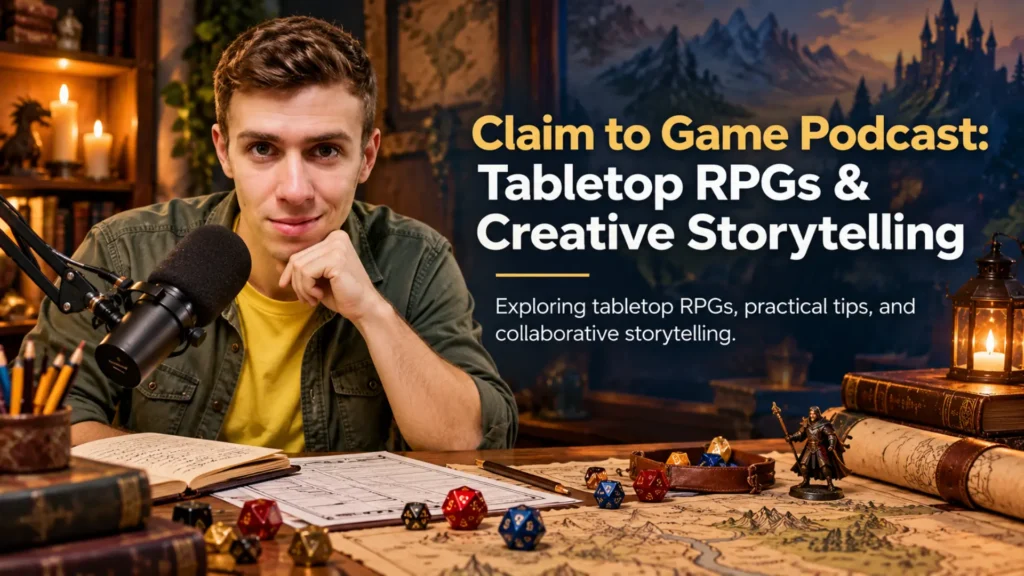
Claim to Game Podcast: Tabletop RPGs & Creative Storytelling
Tabletop role-playing games offer a distinctive form of entertainment where imagination, shared storytelling, and player decisions shape the experience. Unlike traditional board games with fixed outcomes, tabletop RPGs allow participants to create characters, explore fictional worlds, and respond to situations that develop through conversation and game rules. Claim to Game Podcast focuses on this creative hobby, exploring the knowledge and practical skills involved in playing and running tabletop games. From understanding basic mechanics to developing memorable adventures, the subject covers a broad range of experiences that make role-playing games accessible to newcomers and experienced players alike.
The tabletop gaming hobby includes many different systems, genres, and approaches to collaborative storytelling. Some games emphasize tactical combat and character advancement, while others prioritize investigation, relationships, exploration, or dramatic choices. Players might follow a published adventure, develop original stories, or participate in games where narrative responsibilities are shared among the group. Understanding these differences helps people select games that match their interests, available time, and preferred playing styles. Learning about tabletop RPGs also involves developing communication, preparation, and creative problem-solving skills that contribute to an enjoyable experience around the table.
Contents
Understanding the World of Tabletop Role-Playing Games
A tabletop role-playing game, commonly abbreviated as TTRPG, is a game in which participants portray fictional characters within an imagined setting. Their actions are guided by a combination of established rules, conversation, and creative interpretation. Many systems use dice to determine uncertain outcomes, although some rely on cards, tokens, or other resolution methods. A game master, sometimes called a GM, typically describes the world, presents challenges, and portrays supporting characters. However, certain games distribute these responsibilities among participants rather than assigning them to one person.
Modern tabletop role-playing games developed from earlier miniature wargaming traditions, with Dungeons & Dragons first published in 1974. Since then, the hobby has expanded into fantasy, science fiction, mystery, horror, historical adventure, and numerous other genres. Systems such as Pathfinder, Call of Cthulhu, and Fate demonstrate how different rules can support different narrative experiences. This variety means that tabletop gaming is not limited to a single style of play. Understanding the basic principles behind role-playing makes it easier to explore new systems without treating every unfamiliar rulebook as an entirely new hobby.
Building Confidence as a Player or Game Master
Learning a tabletop RPG involves more than memorizing rules. Players benefit from understanding how their characters interact with the fictional world, what choices they can make, and how the game resolves uncertainty. Game masters develop additional skills, including describing environments, managing pacing, interpreting rules, and responding to unexpected decisions. These abilities improve through preparation and repeated play rather than requiring complete mastery before the first session.
A practical starting point is to learn the core mechanic of a chosen system and become familiar with the information recorded on a character sheet. Many games provide introductory adventures or simplified rules that demonstrate how the system works. New game masters can begin with a short scenario containing a clear objective, a few interesting characters, and several meaningful choices. Preparing every possible outcome is rarely necessary because player decisions naturally introduce unexpected developments. The goal is to understand the game’s structure well enough to support creative participation while keeping the experience enjoyable for the entire group.
Creating Memorable Stories Through Collaborative Play
Storytelling is central to tabletop role-playing games, but the story rarely belongs to a single participant. Game masters may establish a setting, introduce conflicts, and describe consequences, while players determine how their characters respond. This interaction produces narratives that cannot always be predicted in advance. A seemingly minor decision, an unexpected dice result, or a conversation between characters can change the direction of an adventure.
Successful collaborative storytelling depends on allowing player choices to matter. A challenge becomes more engaging when participants understand what is at stake and can approach the situation in different ways. Combat, exploration, negotiation, and investigation are all opportunities for meaningful decisions rather than activities that must follow a predetermined sequence. Good communication also helps groups balance dramatic tension with humor, discovery, and moments of character development. These principles apply across many tabletop RPG systems, regardless of their complexity or fictional setting.
Choosing a Tabletop RPG That Fits Your Group
Selecting an appropriate game begins with understanding what participants enjoy. Dungeons & Dragons is widely associated with fantasy adventures, character classes, and encounters resolved through a twenty-sided die. Pathfinder Second Edition also supports fantasy adventures but offers its own detailed approach to character options and tactical decisions. Call of Cthulhu emphasizes investigation, mystery, and cosmic horror, while Fate provides flexible mechanics for narrative-focused adventures. Games such as Fiasco demonstrate that memorable role-playing can also take place without a traditional game master.
Group preferences are just as important as the rules themselves. Some players enjoy extended campaigns with recurring characters, while others prefer self-contained adventures that can be completed in one or two sessions. Available preparation time, session length, complexity, and tone should all influence the decision. There is no universally ideal tabletop RPG because different systems are designed to support different experiences.
Preparing Engaging Adventures Without Excessive Planning
Game preparation helps establish a clear direction while leaving space for improvisation. A useful adventure framework includes an initial situation, a meaningful problem, interesting locations, and characters with understandable motivations. Obstacles should create opportunities for decisions rather than force players toward a single predetermined solution. This approach allows the game master to respond naturally when participants develop unexpected strategies.
Preparation can also focus on information that is difficult to invent during play. Maps, relevant rules, character names, and important clues can be organized before a session begins. However, detailed scripts for every conversation or possible action are usually unnecessary. Flexible preparation makes it easier to preserve player agency while maintaining narrative consistency.
Encouraging Communication and Positive Table Experiences
Tabletop RPGs are social activities in which individual preferences influence the collective experience. Clear communication helps groups establish expectations about scheduling, participation, rules, and storytelling style. A session zero, held before a campaign begins, is one commonly used opportunity to discuss these subjects. Groups can also identify themes they want to explore and content they would prefer to avoid.
During play, game masters can encourage participation by giving different characters opportunities to contribute. Players can support one another by respecting decisions, sharing attention, and separating fictional disagreements from personal conflicts. When unexpected problems arise, discussing them openly can prevent misunderstandings from affecting future sessions. These habits help create an environment where creativity and cooperation remain central to the game.
Exploring Tabletop Gaming Beyond the Rulebook
The broader tabletop RPG hobby includes much more than learning game mechanics. Adventure design, character development, improvisation, worldbuilding, collaborative storytelling, and group dynamics all influence how a session unfolds. Experienced players may explore alternative systems, experiment with different game-mastering techniques, or compare how various genres approach narrative challenges. Newcomers can develop familiarity with the hobby by learning these concepts gradually instead of trying to master everything at once.
Gaming podcasts and educational discussions provide another way to examine tabletop role-playing from multiple perspectives. Claim to Game Podcast represents this interest in understanding how games work and how people can develop their skills as participants and storytellers. Discussions about game selection, adventure preparation, narrative structure, and player experiences reflect the practical questions that arise throughout the hobby. By considering both the mechanical and social aspects of role-playing, players can build a stronger understanding of what makes tabletop adventures engaging, flexible, and memorable.
What is a tabletop role-playing game?
A tabletop RPG is a collaborative game where players portray fictional characters and use rules, conversation, and imagination to develop a shared story.
Do tabletop RPGs always require a game master?
No. Many traditional games use a game master, but some systems support cooperative or GM-less play.
Can beginners learn tabletop RPGs without previous gaming experience?
Yes. Beginner-friendly rules, introductory adventures, and short practice sessions can help new players understand the fundamentals.